Warrior Football Fundraising Golf Tournament
Be sure to check out the Warrior Football Summer 2013 Newsletter.

As mentioned in the newsletter, I will be hosting a special fundraising Golf Tournament to support the Waterloo Warrior Football program. This will be held at Markland Woods on Tuesday, September 17.
For more information, contact Marshall Bingeman at mbingema@uwaterloo.ca. Shotgun start, limited to 18 foursomes, dinner and first class treatment!
Vietnam and Canada – Partnership In Healthcare
Canada and Vietnam have much to celebrate internationally – Canada’s natural resource management, for example, has prompted world recognized innovation in mining and processing for mined material, Canada is a leader in banking innovation and it is also recognized worldwide for its expertise in healthcare. Canada, however, is more widely known for being understated when promoting achievements. Vietnam, in direct contrast, has emerged in recent years as the engine in ASEAN (Association of South East Asian Nations) and has fast become a go to investment market from other Asian and western markets. Canada has been tacitly interested in Vietnam – until recently. Much has been noted in Canada about the emerging opportunity in Vietnam and the hyper-growth that is being realized there as a result of investments in certain sectors – now including healthcare.
 From left to right Marc Kealey, principal Triple Eye Corp; His Excellency Le Sy Vuong, Ambassador; David Tsubouchi, principal Triple Eye Corp and Co-Chair CVBC; Danny Leung, Principal Triple Eye Corp and Co-Chair  |
The government of Vietnam recognized early that outreach and collaboration with western economies is the life-blood for growth and economic stability. One initiative in recent years that capitalized on the special relationship shared between Canada and Vietnam is the establishment of the Canada Vietnam Business Council, an initiative of the government of Vietnam. Vietnam’s government and business community realized, too, that Canada is a country that should have stronger and longer term economic relations with Vietnam. This was demonstrated when Canada’s Governor General, the Rt. Hon. David Johnston visited Vietnam in 2012 and recently Canada’s Minister of Foreign Affairs, Hon. John Baird visited the nation to promote more trade between the two countries. This past February, Canada’s Prime Minister, Stephen Harper, celebrated “Tet” among Canada’s largest Vietnamese-Canadian community in the Greater Toronto Area, officially signalling the importance of the relationship between Canada and Vietnam.
From a more tangible perspective, healthcare in Vietnam is one of the more important public policy issues facing the country. At a 2010 meeting in Toronto, Canada between His Excellency Le Sy Vuong Ha, Ambassador to Vietnam and members of the Canada Vietnam Business Council the topic of healthcare was the focal point.
Specifically, the Ambassador recognized that Vietnam and Canada have a special relationship. He pointed out that Vietnam’s understanding of Canadian healthcare and, particularly, its knowledge of the structure of Canada’s healthcare system – publicly funded and privately delivered – place Vietnam uniquely in a position to exploit opportunities to promote private sector investment in healthcare in their country. Canada’s healthcare system, by virtue of its funding mechanism(s) make it one of the most unique systems in the world. That noted, however, Canada – specifically trade organizations and government, must do a better job to promote its healthcare system to and in emerging markets like Vietnam and by extension ASEAN, but that is a topic for another day.
Today, the Vietnamese economy continues to strengthen and Vietnamese citizens in urban areas reap the economic benefits of this growth – specifically Hanoi and HCM City. Social and lifestyle issues continue to improve as the Doi Moi (the renovation policies) unfold. However, for some Vietnamese there remains a disparity in health equity and, as such, health quality and access to health services available in Vietnam have not kept pace. “There is tremendous stress on the public system in Vietnam and alternative, private sector based opportunities have to be unlocked. There is, however, one immutable benefit of the Doi Moi – a segment of the population of Vietnam are becoming wealthier. As such, the opportunity to access quality healthcare for those with means in the country is terribly limited so most Vietnamese with economic means, seek personal healthcare outside Vietnam”, said Marc Kealey, a principal at Triple Eye Corporation of Canada – a health infrastructure company.
Ambassador Ha cited numbers as high as six billion dollars ($6 billion) a year that is spent outside of Vietnam by its citizens seeking healthcare services in countries like Singapore, Malaysia, Japan, Australia and China. Those countries reap the benefit of Vietnam’s developing healthcare system, while Vietnam struggles through its renovation policies. Ambassador Ha, through myriad meetings with the Canada Vietnam Business Council and Triple Eye Corporation, expressed the desire and rationale of his government to repatriate that capital, encourage direct foreign investment in healthcare in Vietnam and encourage more private sector investment in healthcare services.
One such company that has risen to the challenge to invest in healthcare opportunities in Vietnam is Canada’s International Infrastructure Inc (better known as Triple Eye), one of the founding members of the Canada Vietnam Business Council (CVBC). Senior partners in the company took up Ambassador Ha’s challenge and travelled to Vietnam in 2010 to answer the call on health care investment opportunities. On the first visit, with other members of the CVBC, Triple Eye participated in an historic signing of a cooperation agreement on developing healthcare opportunities there.
With considerable experience in developing and designing emergency medical services, Triple Eye executives have worked in Latin America, Eastern Europe and other Asian countries. On the visit in 2010, members of Triple Eye – Marc Kealey and Danny Leung met with the Chair of the Dai An Joint Stock Company (JSC), Madame Phuong Truong Tu ,whose organization operates one of Vietnam’s largest economic free trade zones – one is located in Hai Duong province, east of Vietnam’s capital city, Hanoi. At meetings in Hai Duong, Madame Phuong made it apparent that her vision matched the vision of Ambassador Ha’s with respect to the necessity of repatriating Vietnamese healthcare dollars in Vietnam. She also offered ideas to improve and provide quality care services for Vietnamese citizens who might otherwise seek their care in foreign jurisdictions – her idea was to look to countries like Canada, Japan, Taiwan and other such places. After an initial qualification process in Vietnam, Triple Eye presented its bona fides and outlined how working together for a protracted period of time (25 years) rather than, say, a five year payback would encourage public policy decision makers in Vietnam to endorse the model of greater participation with Canada in healthcare investment. Triple Eye and Dai An immediately began to negotiate.
Months later and several trips back and forth to Vietnam and Canada (for both parties), agreement was reached on a site for a hospital to be built at the Dai An Industrial Zone along Hwy 5 in Hai Duong province – east of Hanoi. The intention to build the hospital, a first between Canada and Vietnam was announced in media after a visit by a large delegation to Canada from Vietnam in June of 2012 and shortly after that Triple Eye spent considerable time in the summer and fall of 2012 in Hai Duong to prepare pre-feasibility on the proposed hospital site.
The Hospital project
Recommended and located on several hectares of serviced land in Hai Duong, the proposed site for what has become known as “Madame Phuong’s hospital project” is strategic for the provision of private sector health services for ex-patriates living in that area of Vietnam and for those in Vietnam with means and for employees and their families who are employed at plants located at the Dai An Industrial zone.
The prefeasibility study, conducted by a team of health specialists led by Marc Kealey of Triple Eye in 2012 determined if the land for siting the hospital was suitable for building a hospital and other practical issues – like sizing – environment and ease of access for patients and their families to the proposed site. Preliminary economic issues were discussed too, including costing and planning. It was determined after considerable study the project is viable and that the overall cost for a 200 bed hospital in Hai Duong would be $265 million dollars.

Site for proposed hospital project at Dai An Industrial Zone, Hai Duong province, Vietnam
Triple Eye delegates Marc Kealey and Danny Leung and officials from Dai An JSC negotiated the terms of reference for the relationship between Triple Eye (the project manager for the proposed hospital) and Dai An JSC. Agreement was reached to proceed as a corporation to build a hospital and that milestone was announced in late summer of 2012 after considerable meetings with government officials in Vietnam including at the most senior of levels at the national government like the Vice Chairman of the country and the Minister of Health. Triple Eye delegates Kealey and Leung also met with senior decision makers at the provincial government in Hai Duong Province. In late summer of 2012 a signing ceremony was held and the cooperation agreement between Dai An JSC and Triple Eye was ratified. A celebratory dinner was held in Hai Duong and attended by hundreds of government, business and Canadian Embassy officials.
The meeting with the Minister of Health in Vietnam bore particular fruit for the proposed hospital project and credibility for the relationship between Dai An JSC and Triple Eye. Of note was the discussion between the country’s Minister of Health and Marc Kealey of Triple Eye where Minister Tien gave endorsement and support for private sector investment in healthcare in her country. The Minister endorsed the agreement between Triple Eye and Dai An JSC and gave an impassioned plea that private healthcare investment was needed for the country because health care policies have not kept pace with the expansive growth in the economy.
The Minister made it clear in her remarks that the government encourages private sector investment in healthcare and her aspirations for such an investment meshed perfectly with that of Ambassador Ha’s about repatriating capital from Vietnamese seeking healthcare in foreign jurisdictions.
Kick-starting health care policy aspirations for any developing nation accrues to the government , she noted, and in the case of Canadian investment in healthcare, like the proposed project to be built by the Dai An Vietnam Canada International Hospital Corporation, there is, seemingly active interest and immediate results for Vietnam. The Minister offered her unqualified support.

Marc Kealey, pictured left meets with Vietnam Minister of Health Nguyễn Thị Kim Tiến at their meeting in Hanoi in late summer 2012 to discuss investment in hospital project

The delegation from Canada meeting with members of the Hai Duong province legislature in fall 2012 at a special meeting to discuss the hospital project considered for at Di An Industrial zone in Hai Duong province. Pictured beside Marc Kealey (centre) to the right are Madame Phuong, Chair of Dai An JSC and partner to Triple Eye Corp
The business case for a private hospital
A private hospital corporation developed by agreement between a Vietnamese Corporation like Dai An JSC and Canadian company Triple Eye Corporation could be of significant benefit to Vietnam says Marc Kealey, principal of Triple Eye Corporation. “It behooves us as Canadians to try and find alternatives within our own system to help Vietnam realize her potential in a global world where health dollars should stay close to home” he says. He noted that options for healthcare are being considered in Vietnam by other countries like Malaysia, China, France and the United States and they are being closely examined to see how they can work. The benefit of a Canadian proposal is that the policy framework for private sector hospital projects or PPPs has worked in Canada and may be adopted in Vietnam.
“Private sector investment in healthcare is the way to go in country’s like Vietnam as the country matures – state run systems without adequate capitalization are never good. And as economies grow, so too, does choice for those with means who live there”, says Kealey. “There is a lot of talk from foreign companies who claim to have all the answers, we aim to have all the pieces in place, make a full contribution and realize the potential we set out to provide with our partner in Vietnam.”
The agreement between Triple Eye Corporation and Dai An JSC has prompted the establishment of a corporation in Vietnam called the “Dai An Vietnam Canada International Hospital Corporation”, which, is now in the throes of achieving its investment certificate. It is anticipated that the certificate will be granted when all the paperwork has been signed off. There have been hurdles and some bureaucracy from both Canada and Vietnam that have slowed things a bit, but the path is clear that a certificate will be granted and the project will begin.
For its part, Triple Eye Corporation of Canada is actively interviewing Canadian companies with who it will partner for the engineering, design, construction and staffing of the 200 bed hospital slated for completion in late 2015.
In the meantime, Triple Eye continues to lecture and promote the project widely across Canada. In recent months it has sought and garnered Canadian medical staff and a recognized Canadian university to work alongside in education and staffing for Vietnamese workers. There continue to be many emails and letters from interested Vietnamese health workers to Triple Eye about employment opportunities and Triple Eye is actively promoting the project to funding partners for financing the project – interest is high.
One of the greatest challenges facing Triple Eye in Canada comes from funding sources who inquire as to how to mitigate risk in Vietnam. This fear, Triple Eye believes comes largely from of lack of practical knowledge of the current Vietnam. “I personally believe that Canadians have to visit Vietnam if they are interested in that market and see for themselves the potential that exists there” says Kealey, “once Canadian business people and those available to deploy finance for large projects like our hospital corporation, well see how the economy is shifting and they will see the enormous opportunity that also exists there. Once that’s realized, the appetite for investment will increase and the fears for risks will be minimized. We have the right partner in Dai An JSC, the right economic environment, the right policy directives set from the highest levels of government in Vietnam and the Canadian Embassy in Hanoi is extremely helpful. Our job is to demonstrate the viability of the project to deploy funding from the finance sector and risk management organizations in Canada to see what we see in Vietnam”, said Kealey.
Time is of the essence for projects of this magnitude and Triple Eye and its partner Dai An JSC is striving to have all its papers in order by the end of summer 2013 to begin construction as soon as possible and have this, the first such hospital, ready for patients in 2015.
Vision 2030 Jamaica a major focus for Diaspora conference
A key focus of discussions and deliberations during this year’s fifth staging of the Biennial Jamaica Diaspora Conference, from June 16 to 19, in Montego Bay, St. James, will be the country’s long-term National Development Plan — Vision 2030 Jamaica.
The plan seeks to position Jamaica to attain developed country status by 2030 and in the process, make it ‘the place of choice to live, work, raise families and do business’.
This will complement the Conference theme: ‘The Diaspora: Partnership for Development’, with trade, development, investment, and the Diaspora’s role through partnership being the overarching focus.
Against this background, the Planning Institute of Jamaica (PIOJ) will be seeking to further deepen dialogue with Diaspora representatives at the conference through the Vision 2030 Jamaica Secretariat; Population and Health Unit; Migration Policy Project Unit; and Community Renewal Programme.
Chief of these activities is the integrated booth which each Unit will combine to mount in the Marketplace. This will centre on Vision 2030 Jamaica and two of the key elements for realising the national vision: community renewal; and development of a National Policy and Plan of Action on International Migration and Development as well as a Diaspora Policy.
PIOJ representatives will also participate in several panel discussions and make a number of presentations over the three days.
Vision 2030 Jamaica Programme Director, Richard Lumsden, notes that “the Conference is structured around the priorities for development”.
Richard Lumsden
Vision 2030 Jamaica Programme Director
He said there will be discussions around the areas of strategic investment in logistics; information and communication technology; tourism; the creative industries; developments in the social sector, health and education among others.
He added that the discussions are expected to explore how to effectively deepen the partnership between Jamaica and the Diaspora, “drawing on the lessons from other countries such as Israel and Ireland”.
One special area of focus this year will be engagements at the community level. Lumsden explained that members of the Diaspora are inclined to have “enduring connections” with their hometowns, communities, and districts. “They have often expressed, certainly with us, an interest in engaging in projects in specific areas of the country,” he said.
To this end, a number of field trips are being scheduled for Diaspora members following the conference’s conclusion on June 19, during which they will visit projects in several communities.
“That (community interest) was part of the rationale for the Community Renewal Programme being such a prominent component of this year’s engagements. That (community engagement) is one of the (new) areas that we see an interest in,” he advises.
The Community Renewal Programme seeks to promote interventions aimed at building capacity for self empowerment at the individual and community levels in the targeted areas, deemed marginalised.
Regarding efforts to heighten the Diaspora’s overall awareness about Vision 2030 Jamaica outside of the biennial conferences, Lumsden said the secretariat has endeavoured to provide information through collaborations with the Ministry of Foreign Affairs and Foreign Trade to representatives through Consular offices globally.
“We have (also) engaged in ‘one-on-one’ discussions with members….(and) actually travelled (on one occasion), at the invitation of (members of) the Canadian Diaspora, to Toronto and made a presentation at one of their events there,” he added.
Noting the extent of the PIOJ’s input in assisting to plan and organise the Conference, Lumsden says the Vision 2030 Jamaica Secretariat and the Population Unit have been engaged, “over the past several months”, in the preparatory work, led by the Ministry of Foreign Affairs and Foreign Trade.
Additionally, he said the Migration Policy Project Unit has engaged in developing the new Migration and Development Policy, which is also scheduled to be discussed, while also having an input in commencing work to draft a Diaspora and Development Policy.
Lumsden also said the conference was aiming to generate an action plan for implementation, during the two-year period preceding the next meeting, to further strengthen the partnership between Jamaica and its Diaspora.
Read the original article on the Jamaica Observer.
Canada to Assist Jamaica with Disaster Response
Members of the delegation: (left to right) Derrick Snowdy and Marc Kealey of Kealey & Associates Inc., Canadian High Commissioner, Robert Ready, Jamaica’s Consul General to Canada, George Ramocan, and Chairman of the Hitachi Power Systems Canada, Ltd, Howard Shearer.
Prime Minister Portia Simpson Miller (3rd right) is seen here with a Canadian delegation that accompanied former Canadian Prime Minister, John Turner (seated) for a meeting on Monday (June 10) at Jamaica House.
Mr Turner told the Prime Minister that Canada stands ready to assist Jamaica with its response to natural disasters and is in the process of organizing a response team. Mrs Simpson Miller in expressing appreciation for this initiative noted that it will strengthen the long standing relations between both countries. She added that Jamaica is taking disaster preparedness seriously ahead of what is predicted to be a very active Hurricane Season.
Background: The former Prime Minister has agreed to serve as patron to the Jamaican Canadian initiative for Disaster Resilience and Response (JCIDRR), a project of the Consulate of Jamaica, Toronto, which seeks to support Jamaica’s objective to develop its capacity against natural and man-made disasters. The visit is in keeping with the beginning of the 2013 Hurricane Season and will help to heighten the importance of the country’s preparedness.
Jamaican Canadian Disaster Preparedness Initiative Gearing Up for Disaster Relief
HONORARY CHAIR and patron of the Jamaican Canadian Initiative for Disaster Resilience and Response (JCIDRR), former Canadian Prime Minister John Turner, says Jamaicans and Canadians alike are being mobilised to assist the country in the event of a natural disaster.
Daraine Luton, Senior Staff Reporter – The Gleaner
The JCIDRR is an organisation established to assist the development of Jamaica’s capacity for disaster resilience and response to minimise the effects of natural disasters.
Turner, who, on Monday, met with Prime Minister Portia Simpson Miller in Kingston, said the organisation is committed to putting in place expertise and financial support to “equip Jamaica with an up-to-date counter-reaction to disaster and avoid the type of situation that Haiti has gone though in the last several years”.
Turner was among several stakeholders who were guests at a Gleaner Editors’ Forum held at the company’s North Street offices on Monday.
“I undertook this role because I wanted to advance the cause of Canadian-Jamaican friendship and the process of shaping a process to anticipate and deal with tragedies such as hurricanes, floods, earthquakes, and other natural disasters that Jamaica and other Caribbean countries face because of geography,” Turner said.
He said the JCIDRR has the support of Canadian Prime Minister Steven Harper.
George Ramocan, Jamaica’s Consul General to Toronto, who played a key role in forming the organisation, said the manner in which response effort was handled in the aftermath of the Haiti earthquake brought home the need for a coordinated response to disasters.
“I am aware of the sort of waste and duplication that occurred. Persons were passionate and sincere about helping, but because of the urgency, the disorganisation, the lack of communication, you find that much that was intended to happen for Haiti did not happen,” Ramocan said.
Ramocan told the Editors’ Forum that the JCIDRR would be partnering with the Office of Disaster Preparedness and Emergency Management to respond to disasters.
engage private sector
Howard Shearer, who is the chairman of Hitachi Canada, and a key player in the JCIDRR, said a critical part of disaster mitigation is the engagement of the private sector.
Shearer noted that the private sector did not only exist to make money, but it also has a sense of social responsibility, which must be encouraged. He said that in engaging private sector interest in Canada, through the JCIDRR, to invest in Jamaica, would redound to the benefit of the country’s disaster resilience building.
“Disaster mitigation and resilience is in the self-interest of the private sector,” Shearer argued.
“They have the assets on the ground, they have the critical infrastructure, they know how to execute, they know where the equipment is, they have the contacts globally, they have the logistics,” Shearer said.
Shearer, whose father, Hugh Shearer, was prime minister of Jamaica, stressed that the engagement of the private sector for disaster mitigation would in no way undermine the role of Government.
Read the original article on the Jamaica Gleaner.
Media Must Help In Disaster Mitigation – Carby
FORMER HEAD of the Office of Disaster Preparedness and Emergency Management (ODPEM), Dr Barbara Carby, says the media must do more to assist the process of disaster mitigation.
Daraine Luton, Senior Staff Reporter – The Gleaner
Speaking at a Gleaner Editors’ Forum on Monday, Carby said the media have not been persistent in pushing the issue of the need for a revised building code.
“I am very disappointed with the media in general. You have no problem in donating square metres of column space to other issues, but surely, the matter of the national building code should be at the front of the agenda at some point,” Carby said.
The existing legislative framework for the regulation of building activities in the island is outdated and experts say it impedes effective regulation and development of a modem building sector.
“The development of a modem legislative framework is particularly urgent and relevant in view of the need to reduce the vulnerability of the built environment and ensure public safety and welfare, minimise damage caused by natural or man-made hazards, prevent squatter settlements, and promote sustainable development,” the Memorandum of Objects and Reason of a 2011 bill to enact a building code said.
The bill fell off the order paper and has not yet made it back to Parliament.
stakeholders carrying fight
Carby is adamant that stakeholders, with the exception of the media, have been carrying the fight for the revised code.
“The engineers have done their bit; the disaster risk-reduction people have done their bit,” she said.
“You need to start pushing this thing seriously,” Carby continued, adding that she was in danger of dying before the building code was enacted.
Jamaica does not have a mandatory up-to-date building code. The current code was enacted in 1908, and an updated code published in 1983 as a policy document is not enforceable by law.
Marc Kealey, assistant to former Canadian Prime Minister John Turner, said the Jamaican Canadian Initiative for Disaster Resilience and Response (JCIDRR) presents an opportunity for Jamaica to deal with issues such as the building code.
Howard Shearer, chairman of Hitachi Canada, and a key player in JCIDRR, said the organisation would be utilising the goodwill that exists in Canada for Jamaica. He said that among the aims is to mobilise investment in Jamaica and build the country’s disaster resilience capacity.
“We have to focus our efforts and focus our leaders and bring the community together because the end result is saving lives,” Shearer said.
Read the original article on the Jamaica Gleaner.
Waterloo Warriors Football Team – the renaissance of a program
Earlier this month I was honoured to be part of a wonderful team of alumni, coaching and university staff who hosted the first annual Waterloo Warriors Football Gala.
The event was a huge success and the money raised places the team well on its way to achieving the Renaissance of the Football program and its fundraising goal. The funds raised from the close to 600 people in attendance will go to scholarships, leadership programs and enhanced training tools – all vital elements of a successful football program.
[singlepic id=63 w=450 h=354]
As with all good things, this wasn’t an overnight success. The journey started over a year ago when a core group of supporters, athletes, faculty and alumni committed their time, energy, support and money to bring the football program at the U of Waterloo back to life after having suffered some major blows in the past.
One element of the plan was a call to action of all former football players, alumni, staff and other interested parties to join together to kick off the Renaissance of the program. After much hard work and planning, this was accomplished with resounding success culminating with the First Annual Waterloo Warriors Football Gala raising over $50,000.00.
Guests were enthralled by the evening’s headliner, former CFL and NFL offensive tackle, Chris Schultz whose message was clear – it’s going to be ok! Guest speakers included legendary Coach Tuffy Knight and newly minted UW coach and CFL great Joe Paoapao. Guests were visibly moved by current Warrior Receiver and top 40 under 40 Award Winner, Brandon Eaket whose emotional and motivational talk was a highlight of the evening. Another highlight was the first annual Ring of Honour inductees – outstanding football athletes at Waterloo who exemplify the spirit of the University of Waterloo’s football program. Four former football players from the 70’s, 80’s, 90’s and 00’s decades were inducted to the Ring of Honour.
I am proud of my association with the University of Waterloo and the Warrior football program, my days there in the early 80’s have netted me many friends and a core group of stalwart Warrior fans and former players alike. Even more so I am proud and honoured to be part of the “team” to bring today’s Waterloo Warriors back to glory.
K&A Team visits India
Late last month, members of K&A’s Infrastructure team travelled to India to investigate project opportunities. During the visit they met with various government officials and members of India’s business community to discuss one of the country’s most ambitious infrastructure projects, the National Waterways Technology project.
The most celebrated part of the visit was the presentation to the villagers in a remote community in southeast India of a mobile hospital as part of K&A’s commitment to the PURA Mission. This initiative was founded by former President Abdul Kalam – his vision is to Provide Urban Amenities to Rural Areas of India.
The presentation of funding for a mobile hospital to be operational in rural communities in southern India was met with deep appreciation and gratitude and it confirmed and strengthened the bond that exists between Canada and India.
The K&A team plans to return to India in late spring to continue this work and present abstracts to members of the National Waterways task force.
The beginning of change
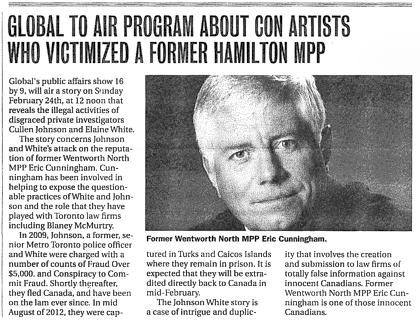
The Internet is the new Wild West and at end of February Global TV’s award winning public affairs show 16 by 9, hosted by veteran TV correspondent Carolyn Jarvis aired an episode specifically about the scams perpetrated on the internet and as a result, the victimization of innocent individuals including Eric Cunningham, former MPP and businessman.
The show focused on the tactics of former police officer and purported hired “private investigator” Cullen Johnson, who with his also disgraced girlfriend Elaine White an unlicensed private investigator, sought systematically to destroy the character of people like Eric Cunningham by falsely suggesting (during his divorce proceedings with his first wife) that he was a part owner of a multi-million dollar company whose blue-chip Board (which included – also falsely- John N. Turner, Mike Harris and David Peterson among others) was in the business, again falsely, of funneling millions of dollars out of Canada. None of the allegations were/are, in fact, true yet the fact that allegations were written and posted on the internet had the effect, at the time, of creating doubt in public (and among those in the legal system) about his integrity and his reputation. The net result was that the falsehoods created animus all around. Thankfully for Eric Cunningham he is a cool customer and because he has integrity dripping from his pores, he used his own network of supporters and the legal system to go after the perpetrators.
As for the stories by Johnson and White – they didn’t stop at Cunningham! Johnson and White created a web of fantastic and false stories on the Internet hurting so many people along the way that they eventually fled the country when they were charged criminally. They fled Canada to the Caribbean when they were out on bail. The two are now imprisoned in the Caribbean for a fraud they alleged to have perpetrated there and are presently awaiting deportation to Canada. When they return to Canada, they will likely be met on arrival by authorities that will, yet again, charge them with several more counts of fraud and they both may face prison sentences here.
This Global TV story is seemingly meant to teach a lesson. It more attempts to highlight the issue of the lack of control on the internet and how the power of words can and do have an affect on any individual’s personal space and an audience the information strives to impact. When people see information on the web, experts say that there is a tendency to actually believe it because it’s written. Couple that with the fact that the “posts” on the web may have a name or a “by-line” attached to it– when, in fact, the real author could be hiding behind an alias from a internet service provider (ISP) in another part of the world, or at a local Starbucks in their home community where the perpetrator of the “post” hides behind Starbuck’s host internet site. As a victim myself of a deliberate attempt to discredit my reputation by “phantoms” claiming to be foreign business people, former colleagues, “private investigators” and other aliases, alleging falsehoods of a libelous and slanderous nature (all of which would be subject to criminal mischief and civil remedies IF a real person alleged same using their true identity on the internet) I believe that change for these kinds of nefarious activities is needed in Canada. I’m fortunate that I have many friends who are helping to “out” these internet predators and that will help more Canadians realize that much of the information on the internet is not as accurate as they would believe. It used to be that we gleaned our information in the “media” through qualified and accurate sources like a newspaper or encyclopedia. Today, anyone can post information on the Internet whether it is accurate or not and hide behind antiquated “broadcast laws” in Canada
Enforcement authorities working with us to identify the “phantoms” posting slanderous and libelous information on the internet using phony names, information and aliases, believe that until and unless Canada as a nation wakes up to the fact that there need to be stiffer laws to protect the public from internet phantoms and predators who use aliases and phony websites, addresses and identities and who maliciously attack and create mayhem for innocent Canadians such as the likes of Johnson and White will continue with impunity. Change has to start now and we have begun the process.
In Canada, like some states in the United States, there needs to be awareness that the Internet is NOT an accurate media to the degree people might believe. That information on “search engines” may not be reliable and the authors, in fact, may not be a real person OR, if they are they may post information that can actually hurt an individual and cause great harm to them (even in some publicized cases cause the victim to end their life). In some southern US states there is pending legislation to amend the criminal code so that law enforcement agencies will charge criminally those who create aliases on the Internet. The intent is to ensure that the address, the name, the posts and the site being used belong to a real person with a real name and real address thereby protecting an individual from cyber-attack from phantoms or phony people. In the United States there seems to be greater protection for reputations of an individual and civil remedies reflect that in past case law – the criminal system is now hoping to catch up.
The days of the internet being the wild west may soon be coming to an end in the US and more and more victims of the kind of malicious and outrageous acts of crime like Eric Cunningham will be vindicated while the spineless internet hacks like the Johnsons and the Whites and others who knowingly perpetrate slander, libel and criminal mischief may find themselves pay heaps of damages in civil courts or wallow in jail – where they belong.
