Jamaica Prepares for Disaster
In the wake of Hurricane Sandy, a storm that ravaged the east coast of the United States in the latter part of 2012, the country of Jamaica has braced itself for any potential disaster through the creation of the Jamaican Diaspora Initiative for Disaster Resilience and Response. This unique entity, confirmed by Prime Minister Portia Simpson early this year attempts to provide emergency response ahead of any disaster that may befall the island nation.
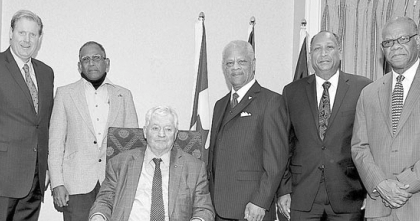
Some of the members of the Jamaican Diaspora Initiative for Disaster Resilience and response include from left to right: Marc Kelley, Dr. Franklin McDonnell, Rt. Hon. John N. Turner, Consul General of Jamaica, Howard Shearer, Bishop Audley James
At the launch of the initiative, it was pointed out that global trends suggest that natural and man-made induced catastrophes are increasing in frequency and magnitude, impacting many nations whether developed, developing or less developed.
The implications are that more countries are facing extreme challenges recovering from these events. It also means that more countries are competing for aide to support recovery and reconstruction efforts.
The Haiti earthquake of 2010 for example exposed many of the challenges that are often experienced by less developed countries which depend heavily on external aide to recover after a catastrophe and frankly, where the logistical infrastructure does not and did not exist previously to ease the process of recovery from that earthquake. Haiti is still struggling three years later, moreover, Haiti has not fully realized the pledged funding and a significant portion of the reconstruction work is yet to begin.
Jamaica has similar vulnerabilities to Haiti, given its location in the hurricane alley, its geography, its geology and its heavy dependence on coastal resources. However, the government and its Diaspora have responded in advance.
The traditional approach has been for Diasporas to contribute primarily to emergency response or early recovery operations after they have occurred.
The situation in Jamaica post Hurrican Sandy, however, requires a novel approach for engagement of the Jamaican Diaspora and its partners to support national initiatives for Disaster Resilience and Response. It was in this light that the Consulate General of Jamaica in Toronto launched the Jamaican Diaspora Initiative for Disaster Resilience and Response in late 2012 confirmed this year by its Prime Minister.
Former Prime Minister of Canada, the Rt. Hon. John Turner, has consented to be the Patron for this initiative. Mr. Turner has strong linkages with Jamaica dating back 60 years and was and is close friends with many government and business officials in and from Jamaica. Other patrons named are prominent Jamaican Canadians, and other Canadians including the deputy chief of police in Toronto, Deputy Crown Attorney for the province of Ontario and prominent business people in Canada.
The advisory group will meet soon to ratify a Board of Directors to carry out the work identified in the Diaspora Relief initaitive’s terms of reference. This is the first such initiative to be announced for a Caribbean nation and other Caribbean countries are following suit.
PURA Trust Awards
An evening in honour of Dr. Lucky Lakshmanan for his outstanding contribution to the PURA Mission.
The Story of PURA
PURA (“Providing Urban Amenities in Rural Areas”) is an initiative founded in 2004 by His Excellency, Dr. Abdul Kalam, former President of India. More than half of all communities in India are rural or remote. As India rapidly moves to first world status, the goal of making basic amenities like good roads, drinking water and healthcare available and accessible is what PURA aspires to provide.
In establishing the PURA Trust, Dr. Kalam believes that a fully developed India can be realized by empowering rural communities and the people who live there. He believes that the establishment and development of physical, electronic and knowledge connections will lead to economic connections among rural villages thereby accelerating rural development.
The PURA Trust In Canada
Dr. Kalam shares a special relationship with Canada borne from the support of governments, academic institutions, business relationships and individuals throughout Canada all of whom recognize that improving the social and economic standing of people in both countries serves to bolster the future development of both.
Canada is well known for expertise in the management of its natural resources and its unique healthcare system. India recognizes the value of this expertise and initiatives like the PURA Trust lean on Canada for its expertise in designing processes and systems to better the economic aspirations and healthcare for developing areas throughout India. The mobile hospital design for PURA is being developed from Canada. The PURA Trust in Canada strives to raise funds and awareness of this initiative.
The PURA Trust Award
Founded in 2012 by Daniela and Marc Kealey, and inspired by the vision of Dr. Kalam transcending boundaries from India to Canada, the PURA Trust Award recognizes the achievements of individuals who have inspired the establishment of physical, electronic or knowledge connections between Canada and India. The Award is granted on an annual basis.
Canada and India share a unique relationship. Both were founded on the principle that hard work and success should be shared. Canada and India have given much of each other to the world. The PURA Trust Award recognizes the achievements of Canadians who have given their talents, energy and resources to further those links between these two great nations and, more importantly, to ensure the sustainability of rural development in India.
Canada celebrates growing importance of Vietnam
The Vietnamese Lunar Celebration TET is an annual event worldwide. In Canada, Prime Minister Stephen Harper visited Mississauga mid-January to celebrate the growing influence of the Vietnam community in Canada by attending TET this year.

The growth of interest about Vietnam in Canada is likely borne from the growing influence of the community in Canada – nearly 350,000 strong – many being professionals and business people across Canada, with quiet effectiveness.
Vietnam boasts one of the fastest growing economies in the Association of South East Asian Nations (ASEAN). What’s not known is that the risk profile favours foreign direct investment (FDI) and stable returns for that investment. We, as Canadians, just need to learn more about Vietnam and its aspirations for the future. Vietnam is tiny country geography-wise, but is home to ninety (90) million people- where practicality and innovation are a characteristic. For example, Vietnam encourages FDI through industrial zones – areas where there is ample land to grow foreign manufacturing facilities. Its workforce is skilled, educated and innovative.
In 2012, Prime Minister Harper challenged Canadians to innovate. Our group took up the challenge, travelled to Vietnam to explore opportunities with one of our most unique selling propositions – health care.

Healthcare in Vietnam is evolving. Most people with means in Vietnam seek their healthcare in places like Japan, Singapore, Malaysia and China. K&A through Triple Eye Inc signed an historic partnership agreement with a local partner to build a Canadian branded hospital in a province (close to Hanoi) where thousands of workers who need health care close to home live and work. Expatriates living in the area are delighted because they believe that Canadian healthcare is the best in the world and they won’t have to travel to other countries to get better healthcare. In fact, Vietnam’s Minister of Health (pictured above – taken in Hanoi September 2012) along with her colleagues in the ministries Foreign Affairs and Foreign Investment see Canadian healthcare as a brand on which to build its new model for domestic healthcare. Other government officials like the project because they believe that repatriating dollars spent outside of Vietnam could be in the billions. Media reports about our particular projects have surfaced and excitement is palpable. We are presently in the process of securing our financing for the project, identifying the EPC partners and getting ready to deploy there in 2013. K&A will be project manager and have agreed to manage the hospital, train Vietnamese healthcare workers and hopefully expand the model to other places throughout Vietnam. It truly is a call action for Canadians taking up the challenge of innovating by exporting our know-how.
Look for more attention from the government of Canada specifically in Vietnam where our hospital project and other opportunities abound and are sure to be celebrated.
Ontario Liberal Leadership
Choosing a political leader at a delegated convention provides all the excitement and intrigue for a political generation. It is, in fact, the ultimate human theatre.
 The stakes are high in all political leadership races, but when the ultimate prize is also to become the Premier of the Province – because the Party seeking its leader happens to be government – the atmosphere, logically, is more electric than normal. Intrigue and drama aside, the Liberal Party of Ontario demonstrated to the Province of Ontario that its leadership hopefuls were prepared to duke it out in a media described well travelled series of debates and public appearances by all seven candidates from November 2012 to late January 2013. The Party’s convention in Toronto held this past weekend was well attended and described by media as well done.
Having attended leadership conventions for all three political parties in Canada since 1976, this convention had the hallmark of being one of the more intriguing I had ever attended. The Party “thinkers” had decided that it wanted a woman to lead its party into the future and punctuated that decision by electing the greatest proportion of the convention’s delegates to the two women in the race. Their campaigns were well run, well funded and attracted the most active caucus support for their respective campaigns. The front runner going in to the convention was Sandra Pupatello, a former MPP and Cabinet Minister in the McGuinty government elected from Windsor and now a prominent Toronto business woman active in the oil and gas sector. The second most favoured candidate was Kathleen Wynne (pictured above) MPP for Don Valley West in Toronto since 2003 and a prominent Cabinet Minister throughout her career as MPP. Hundreds of delegate numbers below Pupatello and Wynne was the remainder of the candidates: Gerrard Kennedy (pictured waving on the far right above) former MPP and Cabinet Minister in McGuinty’s government and a one time MP in Toronto started the convention in third place. Charles Sousa (pictured above far left) MPP from Mississauga South elected in 2007 and, until entering the race, was a Cabinet Minister was in fourth place. Harinder Takhar, MPP for Mississauga Streetsville, elected in 2003 and a Cabinet Minister for his entire career was in fifth place. Prominent Canadian physician and activist Eric Hoskins, (pictured right behind Wynne above) MPP and Cabinet Minister since a by-election in 2009 from St. Paul’s rounded out the cast of hopefuls in sixth place. There was a seventh candidate, Glen Murray, MPP from Toronto Centre Rosedale and a Cabinet Minister since his by-election victory to that seat in 2009 , but he dropped out of the race and chose to support Kathleen Wynne a week before the convention.
Leadership conventions are dynamic events no doubt – the speeches from the candidates are a highlight and often reveal to delegates who has the “mustard” . The two front runners did not disappoint with both of them making superbly crafted speeches. However from this insider’s perspective Kathleen Wynne’s speech was the best delivered with a folksy style that characterized her as likeable (a trait that is known in the business as being “retail”). Pupatello’s speech was strong on content and delivery but seemed to pale in comparison to Wynne’s.
That noted, moreover, political leadership conventions are neither won nor lost on speeches, they are won and lost on delegate support. Delegate support is the ingredient for human dynamic at these kinds of events and deals between candidates were struck before the convention actually began and although speculation abounds, many arm-chair political pundits could not have known the outcome of those deals in advance of the convention.
Such was the case for this Liberal Leadership Convention. After a lengthy and quite frustrating delay in the counting of the first ballots, the result was a razor thin margin for front runner Sandra Pupatello. The surprise after the first ballot was Kathleen Wynne who had generated more delegate support than had been originally anticipated and therefore generated the most momentum. Eric Hoskins was dropped from the ballot and moved quickly to Kathleen Wynne, while his most prominent supporter, former Prime Minister John Turner moved to Sandra Pupatello. At the same time, Harinder Takhar moved to Pupatello leaving only four candidate for the second ballot because there was not a clear fifty percent plus one (50% +1) delegate margin for any one candidate.
After another lengthy delay in the counting of the second ballot results and a spate of discussions among the candidates for last minute deals, Charles Sousa and Gerrard Kennedy moved to Kathleen Wynne making for the most drama of the day and creating some vitriol among their delegates making the third and final ballot for leader of the Party and Premier an historic battle between two women. It was Wynne who won the day with a two hundred and fifty (250) plus margin of the over 2000 delegates voting.
Wynne became the Party’s Leader and the Province’s Premier late evening on Saturday.
For the majority of people who never get the chance to experience this kind of an event, many wonder what happens now?
Here’s the drill.
Kathleen Wynne by winning the Leadership of her Party also becomes what is known as Premier- designate until she and her Cabinet are sworn in. That process of choosing a Cabinet will occur in the next few weeks. She will then be Premier. Her choices for Cabinet Ministers comes from several criteria including: any deals made at the Leadership Convention, geography (where the MPP is elected from), demography (gender, ethnicity etc) and merit. That process will likely not be completed until the night before the Cabinet is sworn in. The swearing in will occur before the Legislature is recalled.
The Premier-designate has said that she will recall the Legislature on February 19, 2013. That means before that date she will have chosen a Cabinet, hired new staffers for the over 300 jobs available for Cabinet Ministers Offices and prepare a Speech from the Throne, which is the agenda her new government will be following in the upcoming Legislative session that ensues.
It is widely speculated that a budget may also accompany the Speech from the Throne, but that is highly unlikely given the protracted period of time from now until the recalling of the Legislature.
It is also widely speculated that Premier-designate Wynne may strike a deal for support of her Speech from the Throne and subsequent Budget Bill from NDP Leader Andrea Horwath to avoid an election this Spring. Speculation is that this minority government could stretch to Spring of 2014.
PC Leader Tim Hudak, our sources tell us, is not as receptive to this kind of a deal and will likely move non-confidence on both the Throne Speech and Budget Bill. Given said support from NDP a non-confidence motion will likely not pass.
Of course, both the New Democrat and PC parties would like a chance at forming a government and speculation abounds that popular support may bounce upward for Liberal Premier designate Wynne in the immediate short term.
Popular support may remain high for Wynne over time because of her personal style , “like-ability” AND if she establishes a brand and style of government so different from the McGuinty Liberal government. In order for this to occur, she will have to address issues from the previous two governments of which she was part and move quickly to remedy them. This includes health, energy and some crown agency troubles that have haunted McGunity’s government in the past 10 years. This could be a tall order given that many of the Cabinet that she will chose will be among the former McGuinty Cabinet for her to demonstrate and ensure continuity, capability and experience. We believe this could be problematic for her – look for some brand new faces and a potential sea change in key roles.
The only saving grace for the opposition parties in this scenario is that they could use the time to hone their public images more effectively, raise badly needed funds and prepare and/or enhance and focus group test their platforms such that they will appeal more to the general public and the media throughout the province.
Couple this with the fact that three term governments tend to “institutionalize” government and become what observers call “fat and lazy”. Political history suggests that it is difficult for a three term government to get a fourth mandate.
Look for drama to unfold prior to this next Legislative session while the elements of a deal for this current minority government to survive unfold.
CFIB’s Communities in Boom
Reading with interest and starting to boil inside about the Canadian Federation of Independent Business (CFIB) report posted in the Financial Post “Communities in Boom”. The report purports to rank cities in Canada (from 1 to 103) based on entrepreneurial activity.
The report gives the top 15 ranking, in large measure, to cities located in Alberta and Saskatchewan. Not bad, given that both provinces are experiencing incredible economic booms.
I must take exception, however, to some of the rankings and the manner in which their relative strengths are ascribed.
Let me begin with St. Catharines-Niagara.
I believe the CFIB makes a glaring mistake linking economic activity and stature to St. Catharines and Niagara. What does it mean to describe St. Catharines and Niagara?
There is a fundamental difference between St. Catharines and Niagara. Niagara is a Region; St. Catharines is a City.
The Region of Niagara is comprised of several cities, many of which I believe are overlooked because of the moniker “Niagara”. It is a “region”.
The City of Niagara Falls, home to one of the most recognizable addresses in the world and to many entrepreneurs who make a very substantial contribution to the economy, get no mention.
The City of Port Colborne, which has re-developed its entire waterfront and downtown and includes some of the best restaurants in the “region”, gets no mention.
Niagara-on-the-Lake, a municipal jurisdiction with Canada’s only remaining “Lord Mayor” as head of its council and home to some of Canada’s best wineries, gets no mention.
The CFIB loses credibility on this front.
Then there is Kitchener. The city is hub to one of the fastest growing small business incubators without it referring to such. It is home to extraordinary development – it is entrepreneurship that has re-shaped the entire downtown core. The Council in Kitchener ought to be given kudos for shaping a political environment that encourages entrepreneurship.
The CFIB report barely gives its strengths on that front.
If an organization as august as the CFIB releases a report and does this with the blessing of the Financial Post, it should not just follow the money. It’s easy to give pats on the back to Alberta and Saskatchewan because the “history of those provinces is based on entrepreneurs…” who settled there. It should not however overlook historical business prowess in Canada’s largest province even during an economic melt down and most assuredly not lump a region into a city.
Triple Eye Agreement to Build New Hospital in Hai Duong, Vietnam

Rt. Hon. John Turner celebrates the legacy of Sir John A. Macdonald

KINGSTON, ON – Commemorating the life of Sir John A. Macdonald
Please see the following articles for this wonderful event:
From one PM to another (thewhig.com)
TURNER TOUR: Former Prime Minister in Kingston (ckwstv.com)
Analysts Dim on ‘Traditional’ Pharmacy and Once Mighty SDM
In the wake of pharmacy reform and massive rebates still flowing to retail chains and independent pharmacy buying groups, the one time darling of the pharmacy world SDM’s future as a investor bet is being openly challenged.
The one time SDM “cheerleader”, analyst Perry Caico of CIBC World Markets, who had been referred to by politicians as THE unbridled stock promoter for SDM, has said he is “concerned” for the once great stock investment.
He claims pharmacy reform and government strong-arming has and will compromise the viability of SDM as the perfect investment.
As the former CEO of the largest professional association of pharmacists in Canada and, immodestly, as a go-to resource for government and private sector organizations on drug plan reform and augmentation, I submit that the issue is not government – it’s a flawed business model in pharmacy.
There is a disconnect between what the public wants and what traditional retail pharmacy in Canada is begging to keep.
In fact, the pall on traditional pharmacy in Canada is not the fault of government. Governments across the country have been and remain concerned that rebates to pharmacy from generic manufacturers artificially keep prices for generic medicines the highest in the world. Pharmacy has been slow to react to government reform from the outset, catering to the notion of staying “whole” rather than adjusting their business models.
I make speeches across North America on drug reform. Audiences tell me they become enraged at what they hear about the massive profits being made by pharmacy when costs continue to rise year over year on private sector plans. It doesn’t make sense in my opinion. With demographic increases in numbers of prescriptions being dispensed, the patent cliff making generic drugs more prolific, one would assume prices and costs would decrease. So how does it work that costs are increasing?
In the work we do, we can confirm that the public and government are ahead of the curve on pharmacy reform and will talk and walk with their feet when confronted with high prices for drugs, variable fee structures from one pharmacy organization to the other and an increasing understanding of how this drug system has set pharmacy up as the biggest beneficiary.
The US, UK, Italy, Spain, Australia, New Zealand and even Ireland have undergone real drug reform. One that doesn’t hide the fact that designing a system means realizing lower costs and prices.
With governments leading the charge on making real change in prescription drug plan reviews and retail pharmacy still playing the game of introducing schemes and ‘blueprints’ to maintain their position – little wonder analysts are turning on the once and mighty chains!!
The beneficiaries are undoubtedly the public and plan members who may see new models considered and introduced.

Economic Club of Canada
Rebuilding the Liberal Party – A Suggested Approach

Let’s face it – Michael Ignatieff’s “Liberal Party” lost the election on May 2, 2011. He, seemingly, only had his own people directing the Party and the results spoke for themselves – Canadians didn’t appear to warm to him. The troubling thing about this loss is that many of my Liberal friends seem to have given up on this Party. I believe all is not lost and what happened after the last election is a symptom of a Party that has lost its groove.
As context, I am a child of the Liberal Party. I grew up being Liberal, I joined the Liberal Party officially when I was 14 years of age, but my great Aunt and Grandmother were active Liberals and encouraged my interest in politics since I was seven. Evening dinners at our home and at family events were characterized by pithy debates about the impact of governments of PMs like St. Laurent, Diefenbaker, Pearson and Trudeau. I knew where the great Wilfrid Laurier’s tomb was in Ottawa when I was in grade one for goodness sakes. There was no doubt that the Liberal Party had a significant impact on me.
The results and ensuing impact of the last federal election have given rise to media speculation about the demise of the Liberal Party. I believe those sentiments are dubious at best. The Liberal Party is a solid brand. Oh, there are some, like a former PM of the great Party, who envision a merger of the Liberal Party and the NDP as a viable option to re-assume power – perhaps. But, if we follow his logic about the Liberal and New Democratic parties theoretically having similar policy principles, then, given that as reason, why doesn’t the Liberal Party reach out to the Conservatives – to merge? The fiscal policies and much of PM Harper’s social policies evidently are centrist – that’s territory the Liberals have claimed since Confederation.
There are others, like me, who believe the Liberal Party can and will find its step once again IF it grasps the principle that the more things change, the more they stay the same. Rebuilding is hard work, it requires slogging it out riding-by-riding, seeking advice from the grassroots, attracting new members, developing new policy AND making an impact.
Consider 1984 to 1988. I came across an article by Susan Delacourt who wrote a very nice article about the recently released biography of John Turner written by Paul Litt (Elusive Destiny: The Political Vocation of John N. Turner – UBC Press, 2011). In her article she outlines the extraordinary accomplishments of Turner in Pearson’s and Trudeau’s governments as well as his friendship with John Diefenbaker (a former Conservative PM). Later in the article she stated that Turner languished in Opposition from 1984 to 1988. As a staff member for him, I can say that is absolutely inaccurate. Turner made a concerted effort and was successful in his personal efforts to rebuild the Party after its devastating (and highly predictable) trouncing in the 1984 election.
Consider that under his leadership, the Liberal Party introduced central fundraising, modernized its headquarters in Ottawa, and that he travelled to more ridings to meet with grassroots members and visit schools to talk with young people than any other Leader in the Party’s history. He developed new policy, provided superb opposition to an effective government and his efforts bore fruit.
The 1988 election, as a result, doubled the fortunes of the Liberal Party in terms of seats won for the House of Commons, saw an increase in membership for the Party, was touted as one of the last best elections the country ever fought and, frankly, paved the way for Jean Chretien to inherit a very good Party, which led to his three majorities in a row.
So, to suggest that the Liberal brand is dead, as some are lamenting at present, is, in my view, giving up. I recall former PM Trudeau’s testimony to the Senate on the changes to our Constitution through the Meech Lake Accord in 1988 – he said, and I paraphrase, that if we give up and provide no opposition to proposed changes to our Constitution, it would be similar to what the male beaver – Canada’s national symbol – does when attacked or cornered – it actually offers up its testicles to its opponent. It was a stark, very poignant moment in Canadian political debate and, in typical Trudeau fashion, had impact
The Liberal Party is a brand, a very well-known brand, and to give it up or let others suggest merger with other parties is similar to Trudeau’s analogy.
We’re better and stronger than that and Turner proved it by re-building when the Party was facing extinction. It’s tough work, but not insurmountable – and now Turner’s the prophet for proving that the brand is relevant.
There is a convention this January 2012 in Ottawa to pick a new President for the Party, let’s see if the Party has the strength to endure and find its groove . . . again!!!
