Archive for the ‘Politics’ Category
The beginning of change
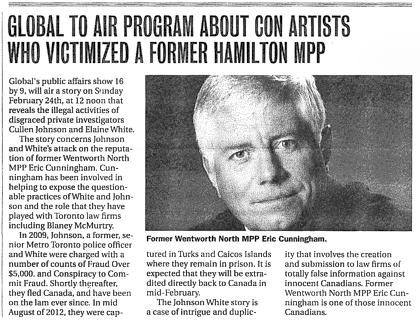
The Internet is the new Wild West and at end of February Global TV’s award winning public affairs show 16 by 9, hosted by veteran TV correspondent Carolyn Jarvis aired an episode specifically about the scams perpetrated on the internet and as a result, the victimization of innocent individuals including Eric Cunningham, former MPP and businessman.
The show focused on the tactics of former police officer and purported hired “private investigator” Cullen Johnson, who with his also disgraced girlfriend Elaine White an unlicensed private investigator, sought systematically to destroy the character of people like Eric Cunningham by falsely suggesting (during his divorce proceedings with his first wife) that he was a part owner of a multi-million dollar company whose blue-chip Board (which included – also falsely- John N. Turner, Mike Harris and David Peterson among others) was in the business, again falsely, of funneling millions of dollars out of Canada. None of the allegations were/are, in fact, true yet the fact that allegations were written and posted on the internet had the effect, at the time, of creating doubt in public (and among those in the legal system) about his integrity and his reputation. The net result was that the falsehoods created animus all around. Thankfully for Eric Cunningham he is a cool customer and because he has integrity dripping from his pores, he used his own network of supporters and the legal system to go after the perpetrators.
As for the stories by Johnson and White – they didn’t stop at Cunningham! Johnson and White created a web of fantastic and false stories on the Internet hurting so many people along the way that they eventually fled the country when they were charged criminally. They fled Canada to the Caribbean when they were out on bail. The two are now imprisoned in the Caribbean for a fraud they alleged to have perpetrated there and are presently awaiting deportation to Canada. When they return to Canada, they will likely be met on arrival by authorities that will, yet again, charge them with several more counts of fraud and they both may face prison sentences here.
This Global TV story is seemingly meant to teach a lesson. It more attempts to highlight the issue of the lack of control on the internet and how the power of words can and do have an affect on any individual’s personal space and an audience the information strives to impact. When people see information on the web, experts say that there is a tendency to actually believe it because it’s written. Couple that with the fact that the “posts” on the web may have a name or a “by-line” attached to it– when, in fact, the real author could be hiding behind an alias from a internet service provider (ISP) in another part of the world, or at a local Starbucks in their home community where the perpetrator of the “post” hides behind Starbuck’s host internet site. As a victim myself of a deliberate attempt to discredit my reputation by “phantoms” claiming to be foreign business people, former colleagues, “private investigators” and other aliases, alleging falsehoods of a libelous and slanderous nature (all of which would be subject to criminal mischief and civil remedies IF a real person alleged same using their true identity on the internet) I believe that change for these kinds of nefarious activities is needed in Canada. I’m fortunate that I have many friends who are helping to “out” these internet predators and that will help more Canadians realize that much of the information on the internet is not as accurate as they would believe. It used to be that we gleaned our information in the “media” through qualified and accurate sources like a newspaper or encyclopedia. Today, anyone can post information on the Internet whether it is accurate or not and hide behind antiquated “broadcast laws” in Canada
Enforcement authorities working with us to identify the “phantoms” posting slanderous and libelous information on the internet using phony names, information and aliases, believe that until and unless Canada as a nation wakes up to the fact that there need to be stiffer laws to protect the public from internet phantoms and predators who use aliases and phony websites, addresses and identities and who maliciously attack and create mayhem for innocent Canadians such as the likes of Johnson and White will continue with impunity. Change has to start now and we have begun the process.
In Canada, like some states in the United States, there needs to be awareness that the Internet is NOT an accurate media to the degree people might believe. That information on “search engines” may not be reliable and the authors, in fact, may not be a real person OR, if they are they may post information that can actually hurt an individual and cause great harm to them (even in some publicized cases cause the victim to end their life). In some southern US states there is pending legislation to amend the criminal code so that law enforcement agencies will charge criminally those who create aliases on the Internet. The intent is to ensure that the address, the name, the posts and the site being used belong to a real person with a real name and real address thereby protecting an individual from cyber-attack from phantoms or phony people. In the United States there seems to be greater protection for reputations of an individual and civil remedies reflect that in past case law – the criminal system is now hoping to catch up.
The days of the internet being the wild west may soon be coming to an end in the US and more and more victims of the kind of malicious and outrageous acts of crime like Eric Cunningham will be vindicated while the spineless internet hacks like the Johnsons and the Whites and others who knowingly perpetrate slander, libel and criminal mischief may find themselves pay heaps of damages in civil courts or wallow in jail – where they belong.
Jamaica Prepares for Disaster
In the wake of Hurricane Sandy, a storm that ravaged the east coast of the United States in the latter part of 2012, the country of Jamaica has braced itself for any potential disaster through the creation of the Jamaican Diaspora Initiative for Disaster Resilience and Response. This unique entity, confirmed by Prime Minister Portia Simpson early this year attempts to provide emergency response ahead of any disaster that may befall the island nation.
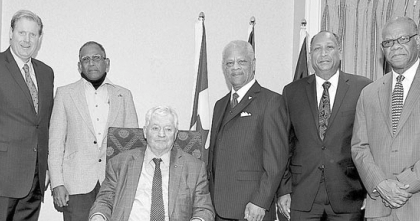
Some of the members of the Jamaican Diaspora Initiative for Disaster Resilience and response include from left to right: Marc Kelley, Dr. Franklin McDonnell, Rt. Hon. John N. Turner, Consul General of Jamaica, Howard Shearer, Bishop Audley James
At the launch of the initiative, it was pointed out that global trends suggest that natural and man-made induced catastrophes are increasing in frequency and magnitude, impacting many nations whether developed, developing or less developed.
The implications are that more countries are facing extreme challenges recovering from these events. It also means that more countries are competing for aide to support recovery and reconstruction efforts.
The Haiti earthquake of 2010 for example exposed many of the challenges that are often experienced by less developed countries which depend heavily on external aide to recover after a catastrophe and frankly, where the logistical infrastructure does not and did not exist previously to ease the process of recovery from that earthquake. Haiti is still struggling three years later, moreover, Haiti has not fully realized the pledged funding and a significant portion of the reconstruction work is yet to begin.
Jamaica has similar vulnerabilities to Haiti, given its location in the hurricane alley, its geography, its geology and its heavy dependence on coastal resources. However, the government and its Diaspora have responded in advance.
The traditional approach has been for Diasporas to contribute primarily to emergency response or early recovery operations after they have occurred.
The situation in Jamaica post Hurrican Sandy, however, requires a novel approach for engagement of the Jamaican Diaspora and its partners to support national initiatives for Disaster Resilience and Response. It was in this light that the Consulate General of Jamaica in Toronto launched the Jamaican Diaspora Initiative for Disaster Resilience and Response in late 2012 confirmed this year by its Prime Minister.
Former Prime Minister of Canada, the Rt. Hon. John Turner, has consented to be the Patron for this initiative. Mr. Turner has strong linkages with Jamaica dating back 60 years and was and is close friends with many government and business officials in and from Jamaica. Other patrons named are prominent Jamaican Canadians, and other Canadians including the deputy chief of police in Toronto, Deputy Crown Attorney for the province of Ontario and prominent business people in Canada.
The advisory group will meet soon to ratify a Board of Directors to carry out the work identified in the Diaspora Relief initaitive’s terms of reference. This is the first such initiative to be announced for a Caribbean nation and other Caribbean countries are following suit.
Canada celebrates growing importance of Vietnam
The Vietnamese Lunar Celebration TET is an annual event worldwide. In Canada, Prime Minister Stephen Harper visited Mississauga mid-January to celebrate the growing influence of the Vietnam community in Canada by attending TET this year.

The growth of interest about Vietnam in Canada is likely borne from the growing influence of the community in Canada – nearly 350,000 strong – many being professionals and business people across Canada, with quiet effectiveness.
Vietnam boasts one of the fastest growing economies in the Association of South East Asian Nations (ASEAN). What’s not known is that the risk profile favours foreign direct investment (FDI) and stable returns for that investment. We, as Canadians, just need to learn more about Vietnam and its aspirations for the future. Vietnam is tiny country geography-wise, but is home to ninety (90) million people- where practicality and innovation are a characteristic. For example, Vietnam encourages FDI through industrial zones – areas where there is ample land to grow foreign manufacturing facilities. Its workforce is skilled, educated and innovative.
In 2012, Prime Minister Harper challenged Canadians to innovate. Our group took up the challenge, travelled to Vietnam to explore opportunities with one of our most unique selling propositions – health care.

Healthcare in Vietnam is evolving. Most people with means in Vietnam seek their healthcare in places like Japan, Singapore, Malaysia and China. K&A through Triple Eye Inc signed an historic partnership agreement with a local partner to build a Canadian branded hospital in a province (close to Hanoi) where thousands of workers who need health care close to home live and work. Expatriates living in the area are delighted because they believe that Canadian healthcare is the best in the world and they won’t have to travel to other countries to get better healthcare. In fact, Vietnam’s Minister of Health (pictured above – taken in Hanoi September 2012) along with her colleagues in the ministries Foreign Affairs and Foreign Investment see Canadian healthcare as a brand on which to build its new model for domestic healthcare. Other government officials like the project because they believe that repatriating dollars spent outside of Vietnam could be in the billions. Media reports about our particular projects have surfaced and excitement is palpable. We are presently in the process of securing our financing for the project, identifying the EPC partners and getting ready to deploy there in 2013. K&A will be project manager and have agreed to manage the hospital, train Vietnamese healthcare workers and hopefully expand the model to other places throughout Vietnam. It truly is a call action for Canadians taking up the challenge of innovating by exporting our know-how.
Look for more attention from the government of Canada specifically in Vietnam where our hospital project and other opportunities abound and are sure to be celebrated.
Ontario Liberal Leadership
Choosing a political leader at a delegated convention provides all the excitement and intrigue for a political generation. It is, in fact, the ultimate human theatre.
 The stakes are high in all political leadership races, but when the ultimate prize is also to become the Premier of the Province – because the Party seeking its leader happens to be government – the atmosphere, logically, is more electric than normal. Intrigue and drama aside, the Liberal Party of Ontario demonstrated to the Province of Ontario that its leadership hopefuls were prepared to duke it out in a media described well travelled series of debates and public appearances by all seven candidates from November 2012 to late January 2013. The Party’s convention in Toronto held this past weekend was well attended and described by media as well done.
Having attended leadership conventions for all three political parties in Canada since 1976, this convention had the hallmark of being one of the more intriguing I had ever attended. The Party “thinkers” had decided that it wanted a woman to lead its party into the future and punctuated that decision by electing the greatest proportion of the convention’s delegates to the two women in the race. Their campaigns were well run, well funded and attracted the most active caucus support for their respective campaigns. The front runner going in to the convention was Sandra Pupatello, a former MPP and Cabinet Minister in the McGuinty government elected from Windsor and now a prominent Toronto business woman active in the oil and gas sector. The second most favoured candidate was Kathleen Wynne (pictured above) MPP for Don Valley West in Toronto since 2003 and a prominent Cabinet Minister throughout her career as MPP. Hundreds of delegate numbers below Pupatello and Wynne was the remainder of the candidates: Gerrard Kennedy (pictured waving on the far right above) former MPP and Cabinet Minister in McGuinty’s government and a one time MP in Toronto started the convention in third place. Charles Sousa (pictured above far left) MPP from Mississauga South elected in 2007 and, until entering the race, was a Cabinet Minister was in fourth place. Harinder Takhar, MPP for Mississauga Streetsville, elected in 2003 and a Cabinet Minister for his entire career was in fifth place. Prominent Canadian physician and activist Eric Hoskins, (pictured right behind Wynne above) MPP and Cabinet Minister since a by-election in 2009 from St. Paul’s rounded out the cast of hopefuls in sixth place. There was a seventh candidate, Glen Murray, MPP from Toronto Centre Rosedale and a Cabinet Minister since his by-election victory to that seat in 2009 , but he dropped out of the race and chose to support Kathleen Wynne a week before the convention.
Leadership conventions are dynamic events no doubt – the speeches from the candidates are a highlight and often reveal to delegates who has the “mustard” . The two front runners did not disappoint with both of them making superbly crafted speeches. However from this insider’s perspective Kathleen Wynne’s speech was the best delivered with a folksy style that characterized her as likeable (a trait that is known in the business as being “retail”). Pupatello’s speech was strong on content and delivery but seemed to pale in comparison to Wynne’s.
That noted, moreover, political leadership conventions are neither won nor lost on speeches, they are won and lost on delegate support. Delegate support is the ingredient for human dynamic at these kinds of events and deals between candidates were struck before the convention actually began and although speculation abounds, many arm-chair political pundits could not have known the outcome of those deals in advance of the convention.
Such was the case for this Liberal Leadership Convention. After a lengthy and quite frustrating delay in the counting of the first ballots, the result was a razor thin margin for front runner Sandra Pupatello. The surprise after the first ballot was Kathleen Wynne who had generated more delegate support than had been originally anticipated and therefore generated the most momentum. Eric Hoskins was dropped from the ballot and moved quickly to Kathleen Wynne, while his most prominent supporter, former Prime Minister John Turner moved to Sandra Pupatello. At the same time, Harinder Takhar moved to Pupatello leaving only four candidate for the second ballot because there was not a clear fifty percent plus one (50% +1) delegate margin for any one candidate.
After another lengthy delay in the counting of the second ballot results and a spate of discussions among the candidates for last minute deals, Charles Sousa and Gerrard Kennedy moved to Kathleen Wynne making for the most drama of the day and creating some vitriol among their delegates making the third and final ballot for leader of the Party and Premier an historic battle between two women. It was Wynne who won the day with a two hundred and fifty (250) plus margin of the over 2000 delegates voting.
Wynne became the Party’s Leader and the Province’s Premier late evening on Saturday.
For the majority of people who never get the chance to experience this kind of an event, many wonder what happens now?
Here’s the drill.
Kathleen Wynne by winning the Leadership of her Party also becomes what is known as Premier- designate until she and her Cabinet are sworn in. That process of choosing a Cabinet will occur in the next few weeks. She will then be Premier. Her choices for Cabinet Ministers comes from several criteria including: any deals made at the Leadership Convention, geography (where the MPP is elected from), demography (gender, ethnicity etc) and merit. That process will likely not be completed until the night before the Cabinet is sworn in. The swearing in will occur before the Legislature is recalled.
The Premier-designate has said that she will recall the Legislature on February 19, 2013. That means before that date she will have chosen a Cabinet, hired new staffers for the over 300 jobs available for Cabinet Ministers Offices and prepare a Speech from the Throne, which is the agenda her new government will be following in the upcoming Legislative session that ensues.
It is widely speculated that a budget may also accompany the Speech from the Throne, but that is highly unlikely given the protracted period of time from now until the recalling of the Legislature.
It is also widely speculated that Premier-designate Wynne may strike a deal for support of her Speech from the Throne and subsequent Budget Bill from NDP Leader Andrea Horwath to avoid an election this Spring. Speculation is that this minority government could stretch to Spring of 2014.
PC Leader Tim Hudak, our sources tell us, is not as receptive to this kind of a deal and will likely move non-confidence on both the Throne Speech and Budget Bill. Given said support from NDP a non-confidence motion will likely not pass.
Of course, both the New Democrat and PC parties would like a chance at forming a government and speculation abounds that popular support may bounce upward for Liberal Premier designate Wynne in the immediate short term.
Popular support may remain high for Wynne over time because of her personal style , “like-ability” AND if she establishes a brand and style of government so different from the McGuinty Liberal government. In order for this to occur, she will have to address issues from the previous two governments of which she was part and move quickly to remedy them. This includes health, energy and some crown agency troubles that have haunted McGunity’s government in the past 10 years. This could be a tall order given that many of the Cabinet that she will chose will be among the former McGuinty Cabinet for her to demonstrate and ensure continuity, capability and experience. We believe this could be problematic for her – look for some brand new faces and a potential sea change in key roles.
The only saving grace for the opposition parties in this scenario is that they could use the time to hone their public images more effectively, raise badly needed funds and prepare and/or enhance and focus group test their platforms such that they will appeal more to the general public and the media throughout the province.
Couple this with the fact that three term governments tend to “institutionalize” government and become what observers call “fat and lazy”. Political history suggests that it is difficult for a three term government to get a fourth mandate.
Look for drama to unfold prior to this next Legislative session while the elements of a deal for this current minority government to survive unfold.
Triple Eye Agreement to Build New Hospital in Hai Duong, Vietnam

Rt. Hon. John Turner celebrates the legacy of Sir John A. Macdonald

KINGSTON, ON – Commemorating the life of Sir John A. Macdonald
Please see the following articles for this wonderful event:
From one PM to another (thewhig.com)
TURNER TOUR: Former Prime Minister in Kingston (ckwstv.com)
Rebuilding the Liberal Party – A Suggested Approach

Let’s face it – Michael Ignatieff’s “Liberal Party” lost the election on May 2, 2011. He, seemingly, only had his own people directing the Party and the results spoke for themselves – Canadians didn’t appear to warm to him. The troubling thing about this loss is that many of my Liberal friends seem to have given up on this Party. I believe all is not lost and what happened after the last election is a symptom of a Party that has lost its groove.
As context, I am a child of the Liberal Party. I grew up being Liberal, I joined the Liberal Party officially when I was 14 years of age, but my great Aunt and Grandmother were active Liberals and encouraged my interest in politics since I was seven. Evening dinners at our home and at family events were characterized by pithy debates about the impact of governments of PMs like St. Laurent, Diefenbaker, Pearson and Trudeau. I knew where the great Wilfrid Laurier’s tomb was in Ottawa when I was in grade one for goodness sakes. There was no doubt that the Liberal Party had a significant impact on me.
The results and ensuing impact of the last federal election have given rise to media speculation about the demise of the Liberal Party. I believe those sentiments are dubious at best. The Liberal Party is a solid brand. Oh, there are some, like a former PM of the great Party, who envision a merger of the Liberal Party and the NDP as a viable option to re-assume power – perhaps. But, if we follow his logic about the Liberal and New Democratic parties theoretically having similar policy principles, then, given that as reason, why doesn’t the Liberal Party reach out to the Conservatives – to merge? The fiscal policies and much of PM Harper’s social policies evidently are centrist – that’s territory the Liberals have claimed since Confederation.
There are others, like me, who believe the Liberal Party can and will find its step once again IF it grasps the principle that the more things change, the more they stay the same. Rebuilding is hard work, it requires slogging it out riding-by-riding, seeking advice from the grassroots, attracting new members, developing new policy AND making an impact.
Consider 1984 to 1988. I came across an article by Susan Delacourt who wrote a very nice article about the recently released biography of John Turner written by Paul Litt (Elusive Destiny: The Political Vocation of John N. Turner – UBC Press, 2011). In her article she outlines the extraordinary accomplishments of Turner in Pearson’s and Trudeau’s governments as well as his friendship with John Diefenbaker (a former Conservative PM). Later in the article she stated that Turner languished in Opposition from 1984 to 1988. As a staff member for him, I can say that is absolutely inaccurate. Turner made a concerted effort and was successful in his personal efforts to rebuild the Party after its devastating (and highly predictable) trouncing in the 1984 election.
Consider that under his leadership, the Liberal Party introduced central fundraising, modernized its headquarters in Ottawa, and that he travelled to more ridings to meet with grassroots members and visit schools to talk with young people than any other Leader in the Party’s history. He developed new policy, provided superb opposition to an effective government and his efforts bore fruit.
The 1988 election, as a result, doubled the fortunes of the Liberal Party in terms of seats won for the House of Commons, saw an increase in membership for the Party, was touted as one of the last best elections the country ever fought and, frankly, paved the way for Jean Chretien to inherit a very good Party, which led to his three majorities in a row.
So, to suggest that the Liberal brand is dead, as some are lamenting at present, is, in my view, giving up. I recall former PM Trudeau’s testimony to the Senate on the changes to our Constitution through the Meech Lake Accord in 1988 – he said, and I paraphrase, that if we give up and provide no opposition to proposed changes to our Constitution, it would be similar to what the male beaver – Canada’s national symbol – does when attacked or cornered – it actually offers up its testicles to its opponent. It was a stark, very poignant moment in Canadian political debate and, in typical Trudeau fashion, had impact
The Liberal Party is a brand, a very well-known brand, and to give it up or let others suggest merger with other parties is similar to Trudeau’s analogy.
We’re better and stronger than that and Turner proved it by re-building when the Party was facing extinction. It’s tough work, but not insurmountable – and now Turner’s the prophet for proving that the brand is relevant.
There is a convention this January 2012 in Ottawa to pick a new President for the Party, let’s see if the Party has the strength to endure and find its groove . . . again!!!
Is Canada on sleeping medication?
I’m here in Hanoi, Vietnam – again. This is my second trip in the last two months. It’s interesting, the last time I was here at the beginning of September; the former Ambassador to Canada and now a noted advisor to the Central Government scolded us by saying “Canada is asleep on Asia Pacific”. I think he’s right!
Our trip this month was to sign a cooperation agreement between the Vietnamese Chamber of Commerce and Investment, which, as many who do international business know, is the government’s external link to other countries seeking business opportunity.
Our signing ceremony was historic, it is the first such agreement between private sector enterprise in Canada and the government of Vietnam. There were noted dignitaries from Vietnam at the event, including the current Vietnamese Ambassador to Canada, who spoke glowingly about Canada and the opportunity that exists between the two countries. There was decent media coverage too, but the meeting was cut short. Why? Because the US government, with a large business contingent, was in the same building as we were to celebrate the 10th anniversary of the trade cooperation agreement between the two countries.
As I reflected on that, I wondered why our Canadian Embassy wasn’t at our event. Why no one from the Canadian government showed up. It’s not as if either wasn’t given ample notice. In fact, on our last visit, we specifically met Embassy commercial counsel to brief up on the event to happen in the ensuing months.
This leads me to my point – Is Canada asleep when it comes to Asia Pacific?
I’d say it has one eye closed. The sum total of Canada’s interest in Asia Pacific lays, in my opinion, with China. Why? Because I believe we think we have a better opportunity there because of the strained relations China shares with the USA.
If the former Ambassador is right about Canada being asleep, and I believe he is, then the opportunity for Canada is the fact that Vietnam is the gateway to ASEAN (Association of South East Asian Nations) – some 680 million people strong. Countries like Cambodia, Laos, Thailand, Indonesia, etc. all of whom need healthcare innovation, quality education, high technology industry and good manufacturing processes and natural resources like oil, gas and minerals.
Canada has traditional north-south dialogue (witness recent free trade agreements with Chile and Colombia).
But what about a dialogue with ASEAN countries?
The Keystone XL fiasco from Obama’s chicken-hearted approach to dealing with environmental lobby groups in Washington is a case in point. Let’s take advantage of his misstep by helping develop ASEAN by putting an elbow bend in the Oil Sands pipeline and having a terminal on the west coast of Canada to deliver our oil to energy developing ASEAN countries.
With this beach-head, we can lay to waste the notion that Canada is asleep and we can use large-scale exports as a means to deliver on other expertise in healthcare, education, hi-tech and other natural resources.
And maybe, just maybe, the Canadian embassies and their commercial counsels in ASEAN countries might wake up and help Canadian business flourish there.

Canada Vietnam Business Council signing ceremony
Election Hangover in Ontario
The impact of the federal election is all but a formality.
The PM is calling back the House of Commons with more than a handful of new MPs and a handsome majority to ensure that a conservative agenda will dominate the Canadian body politic.
Many media, political observers and analysts believe that the PM’s Conservative government will define itself as good managers of the economy while being mindful of the needs of Canada’s growing cohort of seniors, those in need, minorities and New Canadians.
This scenario places the PM and his government squarely in the enviable political centre.
In Ontario, we’re almost five months away from a provincial election. The governing Liberals, once thought to be a spent force are defining the agenda for the election – good government, good social policies, good economic managers, good outreach, collaborative where it counts and tough and unafraid when they need to be. In effect, all the hallmarks of a centrist Party.
Notwithstanding the balance of power theory, which has always been alive and well in Ontario, the case cannot be made casually that the hangover from the federal election will permeate the outcome of the election soon to be fought in Ontario.
The media about and public images of the three Leaders in Ontario, the strategies to be employed during the campaign and math will all have an impact on this Ontario election in October of this year.
In as much as we need a provincial government in Ontario that has courage and knows the aspirations of its citizens – the winner of the election in Ontario will be the Party whose mission resonates successfully from the centre of the political spectrum – and I think we know what Party that could be this fall.

