Archive for the ‘Politics’ Category
Canada India Foundation Meetings
Canada India Foundation meeting with Justin Trudeau
In my role as a Board member of the Canada India Foundation, we’re meeting with several prominent MPs in government and Opposition. One of our first private meetings was with Justin Trudeau MP and Leader of the Liberal Party to discuss our aspirations for Indo Canadian collaboration.
We were pleased with our meeting with Hon Joe Oliver at the gala and with members of the House of Commons.
Celebrating Jim Flaherty
[singlepic id=77 w=400 h=380 float=center]
Jim’s untimely death has shocked the country. For those of us who worked with and for him as a politician and knew him well from Whitby, Toronto and Ottawa and were anxious to see how life after politics was going to be for him in years to come it is particularly sad that a life so large was cut so short.
Condolences and expressions of sympathy to Christine his wife and his three boys can never assuage the hurt and loss. It is painful beyond words to lose a husband and a father.
Words are never enough – Jim was simply a better man!
You are missed.
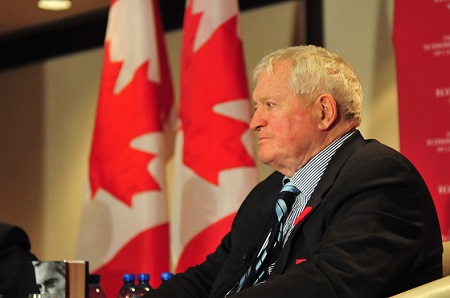
Turner reflects on making a difference in the lives of Canadians
By Roderick Benns
When former Prime Minister John Turner reflects on the years he spent as a progressive minister under both Lester Pearson and Pierre Trudeau, he is satisfied he made important social changes for all Canadians.
Asked to consider a time in politics when he knew he was making a difference in Canadians’ lives, Mr. Turner says he “had a lot to do with a number of situations that affected people directly.”
Mr. Turner pointed out he was involved with legislation and departments that had many direct connections to Canadians under both Prime Ministers Pearson and Trudeau.
“For instance, I always believed in balancing individual rights against those of corporations,” says Mr. Turner.
That’s why the former leader says he was proud to introduce the bill in the House of Commons in 1967 that created the Department of Consumer and Corporate Affairs – and then he led it.
“I headed up the Department of Consumer and Corporate Affairs which gave a balance in the legal rights between consumers and corporations,” Mr. Turner says.
As John Turner biographer, Paul Litt writes, this “fit with his concern for the rights of the average Canadian in the face of impersonal bureaucracy…”
Litt notes that for Mr. Turner it was “also a matter of social justice; the poor…commonly paid more because they lacked access to consumer choice and got stuck with the highest interest rates.”
Under former Prime Minister Pierre Trudeau, Mr. Turner was appointed minister of justice in 1968 – a post he held for four years. It was during this time that Mr. Turner sponsored Criminal Code reform.
“At the justice department, I established the federal court of Canada,” where trials and hearings were heard across Canada, he says. The court also strengthened the rights of individual defendants on trial. Mr. Turner also got rid of the tradition of party patronage in the appointment of judges. He also set up the Law Reform Commission.
During a key time in Canada’s history, Mr. Turner would also direct the Justice Department under the War Measures Act. He was also minister of finance from 1972-1975.
After years as a successful lawyer, Mr. Turner was convinced to seek the leadership of the Liberal Party in 1984. Mr. Turner won and became prime minister when Mr. Trudeau left office. Losing to Brian Mulroney in 1984, he nonetheless doubled the Liberal seat count in the next election, in 1988. He remained Liberal leader and leader of the opposition until 1990. He then retired from politics once again to resume his legal career.
Did You Know?
John Turner is known as Canada’s ‘fastest prime minister,’ for his distinguished athletic record while in university. In the late 1940s, Turner was one of Canada’s top sprinters. In fact, he set the Canadian record in the 100-yard dash, running it in 9.8 seconds in 1947.
The University of British Columbia sprinter also dominated the 100-and-200-yard events. He even qualified for the 1948 London Olympics, but a car accident closed this window of opportunity.
Mr. Turner, a Rhodes Scholar, studied law at Oxford and in 1954 was called to the Quebec Bar.
Click here for original article.
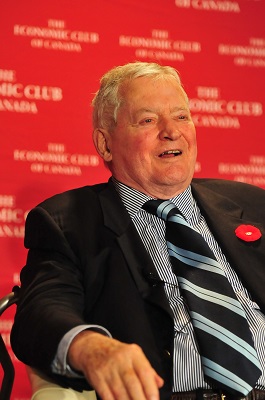
John Turner says he is in favour of a ‘formal’ Canadian prime ministers’ club
By Roderick Benns
Canada’s 17th prime minister says he is in favour of a formal prime ministers’ club that could concentrate on national and international issues.
Former Prime Minister John Turner says the idea of a club where former leaders gather to meet doesn’t have to be in the American tradition.
“We don’t seem to have that tradition here, like the Americans do. If we did it, we could be a little more formal and less haphazard,” he says.
In the U.S., the presidents’ club was established at Dwight Eisenhower’s inauguration by Harry Truman and Herbert Hoover.
According to the book The Presidents Club: Inside the World’s Most Exclusive Fraternity, by Nancy Gibbs and Michael Duffy, “Truman enacted one Hoover recommendation after another, and sent the 71-year-old former President on a 50,000-mile mission around the world: with Truman’s encouragement (he)…met with seven kings, 36 Prime Ministers and the Pope. When he was in Cairo in April of 1946, he and Truman did a joint radio broadcast exhorting Americans to conserve food…And it worked; by the end of that summer, Truman could announce that America had shipped five and a half million tons of grain to the ravaged regions of Europe, thereby keeping the nation’s promise and forestalling a humanitarian catastrophe.”
However, after this auspicious beginning the cooperation level of the presidents would stall and occasionally be revived depending on circumstances.
After Nelson Mandela’s death, Canadians were recently surprised to see Prime Minister Stephen Harper aboard Royal Canadian Air Force 001, flying to the funeral with three of his predecessors — Kim Campbell, Jean Chrétien and Brian Mulroney. Former Prime Minister Joe Clark met the three in South Africa.
Even public photo ops among former PMs are rare. However, Mr. Turner tells Leaders and Legacies that it’s logical for former leaders to meet and discuss issues.
“Overall it makes some sense to discuss international and national concerns.”
In a previous interview with Leaders and Legacies, former Prime Minister Paul Martin said he will soon be working on an initiative that will involve one former prime minister — Joe Clark. He said it has something to do with Aboriginal Canada, the cause closest to Mr. Martin’s heart.
When asked who else he might like to work with and on what issue or cause, Mr. Martin singled out former Prime Minister Brian Mulroney as someone who “is very interested in Aboriginal issues.”
Mr. Martin says that working with former leaders for Aboriginal Canada and Aboriginal education would be something he would be interested in.
“I would welcome any involvement that helps with this.”
Click here for original article.
John Turner calls Ukraine political unrest a ‘political tragedy’
By Roderick Benns
Just one decade ago, former Prime Minister John Turner recalls the unforgettable demonstration of democratic power in Ukraine.
After a late November, 2004 election in which most election observers reported massive fraud on the part of the governing party, a re-run of the presidential election occurred about a month later after great Ukrainian and international pressure.
Mr. Turner, now 84, was a key witness to that historic second chance. That’s because then-Prime Minister Paul Martin handpicked Mr. Turner to lead the largest election delegation in Canada’s history, calling him a “tremendous defender of parliamentary democracy.”
Mr. Turner led a 500-person monitoring team under the first-ever mission of the Canada Corps.
“I led the team to Kiev and across Ukraine to patrol Election Day. It was the Orange revolution and it was one of the greatest demonstrations of democracy I have ever witnessed,” Mr. Turner says.
Turner, who still works five days a week in Toronto doing promotional work in energy and the environment, is dismayed at the state Ukraine finds itself in today.
“The last 10 years have been a political tragedy. You have to listen to the people,” Mr. Turner tells Leaders and Legacies.
“Those in charge of political affairs of the country need to open their ears and their eyes and be available to the people – that’s the secret to success.”
Canada was among the first to recognize Ukraine’s independence from the Soviet Union more than two decades ago. Canada’s connection with Ukraine has been strong, anchored by massive waves of immigration from the country since the turn of the twentieth century under former Prime Minister Wilfrid Laurier.
Democracy not an accident
The example of Ukraine’s lost decade in democratic renewal allows Canada’s 17th prime minister to reflect on Canada. Mr. Turner points out that he spoke to the Kiwanis Club of Montreal in 1963 and advocated for free votes in parliament except for budgets and the throne speech.
“I’m also in favour of strong standing committees, in favour of private members bills, and opening up question period,” said Mr. Turner.
Mr. Turner says Canada must stay “an open country” in practice and spirit.
“Democracy does not happen by accident. Citizens need to be active and parliament needs to be open to the people. There has to be political independence in parliament and in the legislature. That means the role of the individual MP has to be established,” said Mr. Turner.
As for more Canadians choosing to get involved in public life and choosing a political career, Mr. Turner says he has been on several committees over 25 years, exploring why young people don’t want to get involved in politics.
“They point to the financial sacrifice, marriage pressure, media pressure on one’s private life, and that the job itself isn’t worth it anymore – that the role of the individual Member of Parliament has diminished.”
Because of all these reasons, says Mr. Turner, “we have to be active in our own democracy” and consider how to bring in new people to renew our institutions.
Click here for original article.
Vision 2030 Jamaica a major focus for Diaspora conference
A key focus of discussions and deliberations during this year’s fifth staging of the Biennial Jamaica Diaspora Conference, from June 16 to 19, in Montego Bay, St. James, will be the country’s long-term National Development Plan — Vision 2030 Jamaica.
The plan seeks to position Jamaica to attain developed country status by 2030 and in the process, make it ‘the place of choice to live, work, raise families and do business’.
This will complement the Conference theme: ‘The Diaspora: Partnership for Development’, with trade, development, investment, and the Diaspora’s role through partnership being the overarching focus.
Against this background, the Planning Institute of Jamaica (PIOJ) will be seeking to further deepen dialogue with Diaspora representatives at the conference through the Vision 2030 Jamaica Secretariat; Population and Health Unit; Migration Policy Project Unit; and Community Renewal Programme.
Chief of these activities is the integrated booth which each Unit will combine to mount in the Marketplace. This will centre on Vision 2030 Jamaica and two of the key elements for realising the national vision: community renewal; and development of a National Policy and Plan of Action on International Migration and Development as well as a Diaspora Policy.
PIOJ representatives will also participate in several panel discussions and make a number of presentations over the three days.
Vision 2030 Jamaica Programme Director, Richard Lumsden, notes that “the Conference is structured around the priorities for development”.
Richard Lumsden
Vision 2030 Jamaica Programme Director
He said there will be discussions around the areas of strategic investment in logistics; information and communication technology; tourism; the creative industries; developments in the social sector, health and education among others.
He added that the discussions are expected to explore how to effectively deepen the partnership between Jamaica and the Diaspora, “drawing on the lessons from other countries such as Israel and Ireland”.
One special area of focus this year will be engagements at the community level. Lumsden explained that members of the Diaspora are inclined to have “enduring connections” with their hometowns, communities, and districts. “They have often expressed, certainly with us, an interest in engaging in projects in specific areas of the country,” he said.
To this end, a number of field trips are being scheduled for Diaspora members following the conference’s conclusion on June 19, during which they will visit projects in several communities.
“That (community interest) was part of the rationale for the Community Renewal Programme being such a prominent component of this year’s engagements. That (community engagement) is one of the (new) areas that we see an interest in,” he advises.
The Community Renewal Programme seeks to promote interventions aimed at building capacity for self empowerment at the individual and community levels in the targeted areas, deemed marginalised.
Regarding efforts to heighten the Diaspora’s overall awareness about Vision 2030 Jamaica outside of the biennial conferences, Lumsden said the secretariat has endeavoured to provide information through collaborations with the Ministry of Foreign Affairs and Foreign Trade to representatives through Consular offices globally.
“We have (also) engaged in ‘one-on-one’ discussions with members….(and) actually travelled (on one occasion), at the invitation of (members of) the Canadian Diaspora, to Toronto and made a presentation at one of their events there,” he added.
Noting the extent of the PIOJ’s input in assisting to plan and organise the Conference, Lumsden says the Vision 2030 Jamaica Secretariat and the Population Unit have been engaged, “over the past several months”, in the preparatory work, led by the Ministry of Foreign Affairs and Foreign Trade.
Additionally, he said the Migration Policy Project Unit has engaged in developing the new Migration and Development Policy, which is also scheduled to be discussed, while also having an input in commencing work to draft a Diaspora and Development Policy.
Lumsden also said the conference was aiming to generate an action plan for implementation, during the two-year period preceding the next meeting, to further strengthen the partnership between Jamaica and its Diaspora.
Read the original article on the Jamaica Observer.
Canada to Assist Jamaica with Disaster Response
Members of the delegation: (left to right) Derrick Snowdy and Marc Kealey of Kealey & Associates Inc., Canadian High Commissioner, Robert Ready, Jamaica’s Consul General to Canada, George Ramocan, and Chairman of the Hitachi Power Systems Canada, Ltd, Howard Shearer.
Prime Minister Portia Simpson Miller (3rd right) is seen here with a Canadian delegation that accompanied former Canadian Prime Minister, John Turner (seated) for a meeting on Monday (June 10) at Jamaica House.
Mr Turner told the Prime Minister that Canada stands ready to assist Jamaica with its response to natural disasters and is in the process of organizing a response team. Mrs Simpson Miller in expressing appreciation for this initiative noted that it will strengthen the long standing relations between both countries. She added that Jamaica is taking disaster preparedness seriously ahead of what is predicted to be a very active Hurricane Season.
Background: The former Prime Minister has agreed to serve as patron to the Jamaican Canadian initiative for Disaster Resilience and Response (JCIDRR), a project of the Consulate of Jamaica, Toronto, which seeks to support Jamaica’s objective to develop its capacity against natural and man-made disasters. The visit is in keeping with the beginning of the 2013 Hurricane Season and will help to heighten the importance of the country’s preparedness.
Jamaican Canadian Disaster Preparedness Initiative Gearing Up for Disaster Relief
HONORARY CHAIR and patron of the Jamaican Canadian Initiative for Disaster Resilience and Response (JCIDRR), former Canadian Prime Minister John Turner, says Jamaicans and Canadians alike are being mobilised to assist the country in the event of a natural disaster.
Daraine Luton, Senior Staff Reporter – The Gleaner
The JCIDRR is an organisation established to assist the development of Jamaica’s capacity for disaster resilience and response to minimise the effects of natural disasters.
Turner, who, on Monday, met with Prime Minister Portia Simpson Miller in Kingston, said the organisation is committed to putting in place expertise and financial support to “equip Jamaica with an up-to-date counter-reaction to disaster and avoid the type of situation that Haiti has gone though in the last several years”.
Turner was among several stakeholders who were guests at a Gleaner Editors’ Forum held at the company’s North Street offices on Monday.
“I undertook this role because I wanted to advance the cause of Canadian-Jamaican friendship and the process of shaping a process to anticipate and deal with tragedies such as hurricanes, floods, earthquakes, and other natural disasters that Jamaica and other Caribbean countries face because of geography,” Turner said.
He said the JCIDRR has the support of Canadian Prime Minister Steven Harper.
George Ramocan, Jamaica’s Consul General to Toronto, who played a key role in forming the organisation, said the manner in which response effort was handled in the aftermath of the Haiti earthquake brought home the need for a coordinated response to disasters.
“I am aware of the sort of waste and duplication that occurred. Persons were passionate and sincere about helping, but because of the urgency, the disorganisation, the lack of communication, you find that much that was intended to happen for Haiti did not happen,” Ramocan said.
Ramocan told the Editors’ Forum that the JCIDRR would be partnering with the Office of Disaster Preparedness and Emergency Management to respond to disasters.
engage private sector
Howard Shearer, who is the chairman of Hitachi Canada, and a key player in the JCIDRR, said a critical part of disaster mitigation is the engagement of the private sector.
Shearer noted that the private sector did not only exist to make money, but it also has a sense of social responsibility, which must be encouraged. He said that in engaging private sector interest in Canada, through the JCIDRR, to invest in Jamaica, would redound to the benefit of the country’s disaster resilience building.
“Disaster mitigation and resilience is in the self-interest of the private sector,” Shearer argued.
“They have the assets on the ground, they have the critical infrastructure, they know how to execute, they know where the equipment is, they have the contacts globally, they have the logistics,” Shearer said.
Shearer, whose father, Hugh Shearer, was prime minister of Jamaica, stressed that the engagement of the private sector for disaster mitigation would in no way undermine the role of Government.
Read the original article on the Jamaica Gleaner.
Media Must Help In Disaster Mitigation – Carby
FORMER HEAD of the Office of Disaster Preparedness and Emergency Management (ODPEM), Dr Barbara Carby, says the media must do more to assist the process of disaster mitigation.
Daraine Luton, Senior Staff Reporter – The Gleaner
Speaking at a Gleaner Editors’ Forum on Monday, Carby said the media have not been persistent in pushing the issue of the need for a revised building code.
“I am very disappointed with the media in general. You have no problem in donating square metres of column space to other issues, but surely, the matter of the national building code should be at the front of the agenda at some point,” Carby said.
The existing legislative framework for the regulation of building activities in the island is outdated and experts say it impedes effective regulation and development of a modem building sector.
“The development of a modem legislative framework is particularly urgent and relevant in view of the need to reduce the vulnerability of the built environment and ensure public safety and welfare, minimise damage caused by natural or man-made hazards, prevent squatter settlements, and promote sustainable development,” the Memorandum of Objects and Reason of a 2011 bill to enact a building code said.
The bill fell off the order paper and has not yet made it back to Parliament.
stakeholders carrying fight
Carby is adamant that stakeholders, with the exception of the media, have been carrying the fight for the revised code.
“The engineers have done their bit; the disaster risk-reduction people have done their bit,” she said.
“You need to start pushing this thing seriously,” Carby continued, adding that she was in danger of dying before the building code was enacted.
Jamaica does not have a mandatory up-to-date building code. The current code was enacted in 1908, and an updated code published in 1983 as a policy document is not enforceable by law.
Marc Kealey, assistant to former Canadian Prime Minister John Turner, said the Jamaican Canadian Initiative for Disaster Resilience and Response (JCIDRR) presents an opportunity for Jamaica to deal with issues such as the building code.
Howard Shearer, chairman of Hitachi Canada, and a key player in JCIDRR, said the organisation would be utilising the goodwill that exists in Canada for Jamaica. He said that among the aims is to mobilise investment in Jamaica and build the country’s disaster resilience capacity.
“We have to focus our efforts and focus our leaders and bring the community together because the end result is saving lives,” Shearer said.
Read the original article on the Jamaica Gleaner.
